 |
| This image shows types of water wells. Dug wells like the one on the left are relatively easy to dig, but are also most seasonal and vulnerable to contamination. Wells that access the groundwater / underwater aquifers are least seasonal and least vulnerable to contamination, but are also hardest to dig. (Wikimedia Commons) |
In Biblical Palestine there were only two rivers of any significant size. Small streams were rare and usually seasonal and there were a few springs, but certainly not enough for the majority of the population to live near to one. So you can imagine that wells were not just important, they were essential to life; so much so that it was assumed that if you owned the well, you owned the land around it. Owning land without a well or water source was rather pointless as water was necessary for crops, animals and of course, for people too.
 |
| A dug well in Kerala, India. (Wikimedia Commons) |
Besides this, actually building wells is quite a mucky and difficult job. Often wells were only big enough for one, perhaps two people to be digging. They would send the dug out material up via buckets, and those at the top would send down stones to reinforce the walls of the well, depending on the substrate they were digging through. You would essentially stop digging when the rate of water seeping in was faster than you could dig dirt out. It was dirty, dangerous and difficult. Alone in the dark, sometimes over 30-40m underground, with dust falling on you from above, clawing and chipping away at the dirt below - it was arduous but essential work.
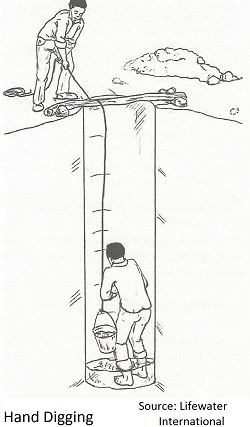 |
| Source: Lifewater International |
Water is such a precious, yet unpredictably finite resource, that it would be difficult to be generous with your well water. Your well was part of your family's wealth, dug to supply the needs of your family first and foremost, often with little to spare.
They were also vulnerable to collapsing or contamination - if an animal fell into the well and died you would have a big problem on your hands. They could also dry up or be vandalised. We see stories of the Philistines filling in the wells that Abraham dug as a form of guerilla warfare. Alternatively, you could also fill in wells that would be passed by enemies on their way to you to effectively block their passage. In order to maintain water supply and protect against siege tactics, many of the more established cities and settlements, like Jerusalem, had cisterns in which they would store water gather during rainy times.
So after that history lesson, you can see how it would be very easy for me to move on to spiritual metaphors:
- Make sure your spiritual wells are deep; dig them as deep as you can, because the deeper the well, the purer and more plentiful and constant the water supply
- We need to defend and guard our wells against contamination
- We need to make sure our cisterns / water stores are not broken / badly maintained so that when barren times come or enemies try to besiege us we have a plentiful supply
But, I think this would be doing you a disservice, because it seems to me that wells represent the Old Covenant way of doing things, where streams and springs represent the New Covenant... I say this for a number of reasons:
Wells represent human effort and cleverness – where springs represent God’s plentiful provision. Even once the work of digging the well is over, getting that water out involves significant muscle power. With a spring, the effort is more in trying to channel the flow – there is no effort needed to get that water going!
Wells represent human effort and cleverness – where springs represent God’s plentiful provision. Even once the work of digging the well is over, getting that water out involves significant muscle power. With a spring, the effort is more in trying to channel the flow – there is no effort needed to get that water going!
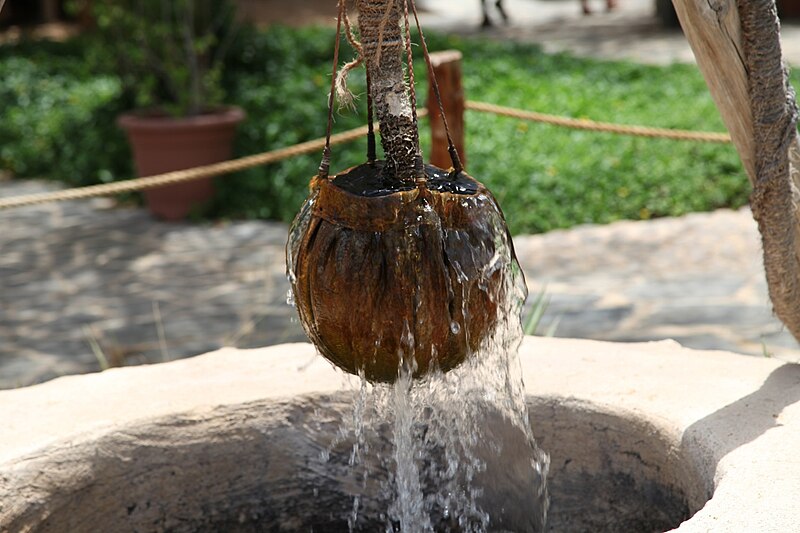
The Hebrew word for 'well' is 'beer' where the word for 'spring' is 'en'. Beer has implications of boring down, finding, moving towards the water, where 'en' literally means 'eye' with the inference of 'springing up' - to me that's a picture of the grace poured out towards us in the New Covenant. No longer are we trying to access God's provision of salvation through our own efforts, but through the incarnation, Jesus comes towards us to bring us living water.
Speaking of Jesus, I’d like to propose that it’s not just me that thinks that wells represent the Old Covenant – when I read about Jesus and the Samaritan woman in John chapter 4 - I have the feeling Jesus felt the same way. This is one of my favourite accounts within the gospels for a number of reasons – and I could spend hours talking about this story – but for today let’s dig a bit deeper...
(Sorry, couldn't help it.)
Let's read the account:
Speaking of Jesus, I’d like to propose that it’s not just me that thinks that wells represent the Old Covenant – when I read about Jesus and the Samaritan woman in John chapter 4 - I have the feeling Jesus felt the same way. This is one of my favourite accounts within the gospels for a number of reasons – and I could spend hours talking about this story – but for today let’s dig a bit deeper...
(Sorry, couldn't help it.)
Let's read the account:
John 4:4-30
Keep in mind, this is the only actual well mentioned in the New Testament.
The 10 Northern tribes started worshiping idols - immediately after the division, Jeroboam changed the worship of the Israelites in 1 Kings 12:25-33. No longer did the inhabitants of the north travel to Jerusalem to offer sacrifice and worship (cf Deuteronomy 12:5-14). Instead, Jeroboam set up idols in Dan and Bethel. This was destroyed by Assyrians in 722BC – with whom the people intermarried - so Samaritans were seen as sellouts: he people of God who rejected temple worship and intermarried with other nations.
4And he had to pass through Samaria. 5 So he came to a town of Samaria called Sychar, near the field that Jacob had given to his son Joseph. 6 Jacob's well was there; so Jesus, wearied as he was from his journey, was sitting beside the well. It was about the sixth hour.
Keep in mind, this is the only actual well mentioned in the New Testament.
So what was up with the Jews and the Samaritans anyway? Quick history lesson: When Saul was crowned the first king of Israel, he ruled over all 12 tribes, as did David and Solomon after him. However, after Solomon died, there was a split in the kingdom. The 10 northern tribes - Asher, Dan, Ephraim, Gad, Issachar, Manasseh, Naphtali, Reuben, Simeon, and Zebulon formed the Kingdom of Israel, and their capital was the city of Samaria. The 2 other tribes - Judah and Benjamin - formed the Kingdom of Judah with its capital at Jerusalem.
7 A woman from Samaria came to draw water. Jesus said to her, "Give me a drink." 8 (For his disciples had gone away into the city to buy food.) 9 The Samaritan woman said to him, "How is it that you, a Jew, ask for a drink from me, a woman of Samaria?" (For Jews have no dealings with Samaritans.)
The 10 Northern tribes started worshiping idols - immediately after the division, Jeroboam changed the worship of the Israelites in 1 Kings 12:25-33. No longer did the inhabitants of the north travel to Jerusalem to offer sacrifice and worship (cf Deuteronomy 12:5-14). Instead, Jeroboam set up idols in Dan and Bethel. This was destroyed by Assyrians in 722BC – with whom the people intermarried - so Samaritans were seen as sellouts: he people of God who rejected temple worship and intermarried with other nations.
10 Jesus answered her, "If you knew the gift of God, and who it is that is saying to you, 'Give me a drink,' you would have asked him, and he would have given you living water."Now we have our own ideas about what this term 'living water' means, largely derived from this passage. But it would have had a different yet specific meaning for this woman at the well. At the very least, 'living water' was flowing water - fresh and cool - as opposed to water that was still or stored.
Traditionally the enmity between Jews and Samaritans was so bad that they couldn't share the same cup - hence the comment about having nothing to draw water with. The woman talks about how this well was provided by Jacob, but Jesus dismisses it as inferior to what he provides. Now Jesus is offering an alternative - himself. He is the fulfillment of the promies.
Living water flows!
11 The woman said to him, "Sir, you have nothing to draw water with, and the well is deep. Where do you get that living water? 12 Are you greater than our father Jacob? He gave us the well and drank from it himself, as did his sons and his livestock."

13 Jesus said to her, "Everyone who drinks of this water will be thirsty again, 14 but whoever drinks of the water that I will give him will never be thirsty again. The water that I will give him will become in him a spring of water welling up to eternal life."The law, the Old Covenant, is never enough to provide for eternal life. Every year a new sacrifice must be made. Every day a new supply must be drawn. With Jesus, the promise is that the law will be written on our hearts, and that we will have a source of living water within ourselves - a spring, a constant flow, not a well that we have to draw from.
15 The woman said to him, "Sir, give me this water, so that I will not be thirsty or have to come here to draw water."This lady has a sense of humour. She knows he is speaking figuratively but takes him literally. I can't wait to meet her one day!
16 Jesus said to her, "Go, call your husband, and come here."In true Jesus fashion, he doesn't answer the question / request directly - but answers the question behind the question - he addresses the source of her shame.
17 The woman answered him, "I have no husband." Jesus said to her, "You are right in saying, 'I have no husband'; 18 for you have had five husbands, and the one you now have is not your husband. What you have said is true." 19 The woman said to him, "Sir, I perceive that you are a prophet.Smart lady! She changes the topic and compliments him - 'I can see you are a smart guy!' and continues by acknowledging his discussion of spiritual topics:
20 Our fathers worshiped on this mountain, but you say that in Jerusalem is the place where people ought to worship." 21 Jesus said to her, "Woman, believe me, the hour is coming when neither on this mountain nor in Jerusalem will you worship the Father.Again, he offers an alternative source of life to that based on the system of temple sacrifices, and emphasizes that it won't be replaced by any alternative system of sacrifice or idol worship as the Samaritans practise - in other words - 'Neither of your religious systems will work.'
22 You worship what you do not know; we worship what we know, for salvation is from the Jews. 23 But the hour is coming, and is now here, when the true worshipers will worship the Father in spirit and truth, for the Father is seeking such people to worship him. 24 God is spirit, and those who worship him must worship in spirit and truth." 25 The woman said to him, "I know that Messiah is coming (he who is called Christ). When he comes, he will tell us all things." 26 Jesus said to her, "I who speak to you am he." 27 Just then his disciples came back. They marveled that he was talking with a woman, but no one said, "What do you seek?" or, "Why are you talking with her?" 28 So the woman left her water jar and went away into town and said to the people, 29 "Come, see a man who told me all that I ever did. Can this be the Christ?" 30 They went out of the town and were coming to him.

I think it is significant here that the text mentions she leaves her water jar. It's as if the revelation that she won't be needing her own well water anymore has sunk in and she knows that she will have springs of living water flowing from within her - she will never be thirsty again.

The idea of springs and living water representing something of the abundance of God's salvation is not a new one in scripture - here are some scriptures from the Old Testament - and you can see they are almost all written in future tense.
Psalms 36:8-9 They drink their fill of the abundance of Your house; And You give them to drink of the river of Your delights. For with You is the fountain of life; In Your light we see light.The scriptures from Jeremiah and Zechariah and Ezekiel are quite interesting, considering that underneath Jerusalem there are massive cisterns designed to store water collected during the winter rainy season to supply the city during the dry summer season. This water became quite brackish and nearly undrinkable toward the end of the summer season as it was 'still' water, not flowing, or 'living' water. Living water flowing out of Jerusalem, from the temple, would have been a miraculous sight!
Psalms 87:7 Then those who sing as well as those who play the flutes shall say, "All my springs of joy are in you."
Isaiah 12:3 Therefore you will joyously draw water From the springs of salvation.
Isaiah 41:18 I will open rivers in high places, and fountains in the midst of the valleys: I will make the wilderness a pool of water, and the dry land springs of water.
Isaiah 49:10 "They will not hunger or thirst, Nor will the scorching heat or sun strike them down; For He who has compassion on them will lead them And will guide them to springs of water.
Isaiah 55:1 "Ho! Every one who thirsts, come to the waters; And you who have no money come, buy and eat Come, buy wine and milk Without money and without cost.
Jeremiah 2:13 "For My people have committed two evils: They have forsaken Me, The fountain of living waters, To hew for themselves cisterns, Broken cisterns That can hold no water.
Zechariah 14:8 And in that day living waters will flow out of Jerusalem, half of them toward the eastern sea and the other half toward the western sea; it will be in summer as well as in winter.
Ezekiel 47 – Describes water flowing from the temple.
Joel 3:18 And in that day The mountains will drip with sweet wine, And the hills will flow with milk, And all the brooks of Judah will flow with water; And a spring will go out from the house of the LORD To water the valley of Shittim.
 |
| Streams of living water will flow from you... |
So for Jesus to promise streams of living water, flowing from redeemed individuals, united as the new temple of the Holy Spirit under the New Covenant, he is describing the fulfillment of these scriptures.
The story of John 4 is quite pivotal as he announces this part of his master plan for the first time - to a Samaritan woman of all people - and goes on to reiterate it later on in John's account:
John 6:35 Jesus said to them, "I am the bread of life; whoever comes to me shall not hunger, and whoever believes in me shall never thirst.
John 7:37 On the last day of the feast, the great day, Jesus stood up and cried out, "If anyone thirsts, let him come to me and drink.
John 7:38 Whoever believes in me, as the Scripture has said, 'Out of his heart will flow rivers of living water.'"
John 7:39 Now this he said about the Spirit, whom those who believed in him were to receive, for as yet the Spirit had not been given, because Jesus was not yet glorified.
And then later in the book of Revelation as well:
Revelation 7:17 for the Lamb in the center of the throne will be their shepherd, and will guide them to springs of the water of life; and God will wipe every tear from their eyes.
Revelation 21:6 Then He said to me, "It is done I am the Alpha and the Omega, the beginning and the end I will give to the one who thirsts from the spring of the water of life without cost.
Revelation 22:17 The Spirit and the bride say, "Come " And let the one who hears say, "Come " And let the one who is thirsty come; let the one who wishes take the water of life without cost.
 |
| Living Water Brings LIFE! |
What does living water look like?
In my understanding, you can see when someone is accessing that living water when they bring life to situations rather than drawing life out of them. Like I said earlier, it is difficult to be generous with well water, you have to get it up and out of the well, the amount you can draw depends largely on your own effort, but with springs of living water, your only responsibility is to direct the flow. If I get my primary sense of value and affirmation from things and people other than Jesus, I can easily fall into the trap of getting my life from them too, but when drawing my life from Jesus, when I allow those streams of living water to flow, then I bring life into those situations and into my relationships.
Living water also refers to the power of the Holy Spirit - as indicated by John 7:39. When I am accessing living water I am allowing the Holy Spirit's power to flow through me and to energise everything that I do. I choose not to rely on my own wells and my broken cisterns, but to accept his moment by moment, life giving flow through my life into the lives of others. When I am not accessing the Holy Spirit's power, I am accessing my own finite resources, making it difficult for me to be radically generous with those resources.
Living water also refers to the power of the Holy Spirit - as indicated by John 7:39. When I am accessing living water I am allowing the Holy Spirit's power to flow through me and to energise everything that I do. I choose not to rely on my own wells and my broken cisterns, but to accept his moment by moment, life giving flow through my life into the lives of others. When I am not accessing the Holy Spirit's power, I am accessing my own finite resources, making it difficult for me to be radically generous with those resources.
I hope you found that interesting. If you found anything unclear or thought I left anything out, please comment below! I'd love to hear from you.


